Humans and AI Working Together Efficiently
Why Human-AI Collaboration Is the Future of Work
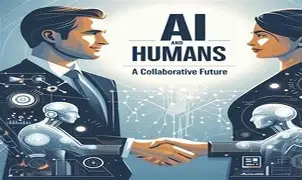
Artificial Intelligence has become one of the most transformative technologies of the 21st century. From automating repetitive tasks to generating creative content and analyzing massive datasets, AI is changing how businesses operate and how people work. Yet despite concerns about machines replacing human workers, the most significant opportunity lies not in competition between humans and AI, but in collaboration.
The future of work is not a world where humans are replaced by intelligent machines. Instead, it is a world where humans and AI work together efficiently, combining the strengths of both to achieve outcomes that neither could accomplish alone.
Humans bring creativity, empathy, ethical judgment, leadership, and critical thinking. AI contributes speed, scalability, data processing, pattern recognition, and automation. When these strengths are integrated effectively, organizations can increase productivity, innovation, and overall performance.
The rise of human-AI collaboration is not just a technological shift—it is an economic and cultural transformation that is reshaping industries across the globe.
Understanding the Strengths of Humans and AI
To understand why collaboration is so powerful, it is important to recognize the unique strengths of each partner.
What Humans Do Best
Human beings excel in areas that require:
- Creativity and imagination
- Emotional intelligence
- Ethical decision-making
- Strategic thinking
- Relationship building
- Leadership and motivation
- Adaptability in uncertain situations
Humans can understand context, interpret emotions, and make decisions that consider social and ethical consequences. These capabilities remain difficult for AI systems to replicate.
What AI Does Best
AI excels at:
- Processing large volumes of data
- Identifying patterns
- Automating repetitive tasks
- Generating content quickly
- Providing predictions and recommendations
- Operating continuously without fatigue
- Scaling operations efficiently
AI can perform certain tasks in seconds that would take humans hours or even days to complete.
The key to efficiency lies in assigning each task to the partner best suited to perform it.
The Shift from Automation to Augmentation
Many discussions about AI focus on automation. While automation is important, augmentation may be even more valuable.
Automation replaces specific tasks.
Augmentation enhances human capabilities.
For example, an AI writing assistant can generate a first draft of an article. However, a human writer provides originality, storytelling, audience understanding, and final judgment.
Similarly, AI can analyze financial data and identify trends. A human executive uses those insights to make strategic decisions based on market conditions, company culture, and long-term objectives.
The most successful organizations view AI as a tool that amplifies human potential rather than replacing it.
How AI Is Transforming Daily Work
Across industries, AI is already becoming an essential workplace partner.
Marketing and Content Creation
Marketing teams use AI to:
- Generate content ideas
- Draft blog posts
- Create social media campaigns
- Analyze customer behavior
- Personalize marketing messages
Rather than replacing marketers, AI allows them to focus on strategy, brand development, and customer engagement.
Software Development
Developers increasingly use AI coding assistants to:
- Write code
- Debug applications
- Generate documentation
- Suggest improvements
- Accelerate testing
This reduces development time while allowing programmers to focus on architecture, innovation, and complex problem-solving.
Customer Support
AI-powered chatbots and virtual assistants handle routine inquiries, enabling human support agents to focus on complex customer issues that require empathy and nuanced understanding.
Healthcare
Medical professionals use AI to assist with:
- Diagnostic imaging
- Patient monitoring
- Research analysis
- Administrative workflows
AI provides valuable insights, while healthcare providers make final decisions and maintain patient relationships.
The Productivity Revolution
One of the greatest benefits of human-AI collaboration is increased productivity.
Traditional productivity improvements often required hiring more employees or extending working hours. AI changes this equation.
Employees can now complete tasks faster without sacrificing quality.
Consider a typical professional who spends time on:
- Email management
- Scheduling
- Research
- Data entry
- Document preparation
Many of these activities can be partially automated through AI systems.
This frees workers to focus on higher-value activities such as innovation, relationship building, and strategic planning.
The result is not simply faster work—it is more meaningful work.
Creativity in the Age of AI
Some people fear that AI-generated content will reduce human creativity. In reality, AI may enable a new wave of creative expression.
Throughout history, new tools have expanded creative possibilities.
The camera did not eliminate painting.
Digital software did not eliminate graphic design.
Similarly, AI is unlikely to eliminate creativity. Instead, it changes how creative work is performed.
Writers can brainstorm ideas faster.
Designers can generate multiple concepts in minutes.
Filmmakers can experiment with visual effects more efficiently.
Musicians can explore new sounds and compositions.
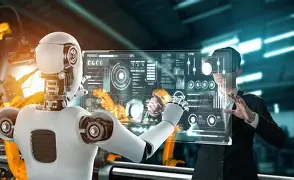
AI becomes a creative partner that accelerates exploration and experimentation.
Human creativity remains the driving force behind meaningful innovation.
Building Effective Human-AI Teams
Organizations must develop strategies for integrating AI into their workforce.
Successful human-AI collaboration depends on several factors.
Clear Role Definition
Employees should understand which tasks are best handled by AI and which require human expertise.
Confusion leads to inefficiency.
Clear responsibilities create stronger collaboration.
AI Literacy
Workers need basic AI knowledge to use these tools effectively.
Organizations should invest in:
- AI training programs
- Digital literacy initiatives
- Continuous learning opportunities
Employees who understand AI can leverage it more effectively and confidently.
Human Oversight
AI systems are powerful but not infallible.
Human oversight remains essential to:
- Verify outputs
- Identify errors
- Ensure ethical compliance
- Maintain quality standards
The most effective systems combine automation with human review.
Continuous Improvement
Human-AI workflows should evolve over time.
Organizations should regularly assess:
- Productivity gains
- Employee satisfaction
- Process efficiency
- Quality improvements
This ensures that AI integration delivers measurable value.
Challenges of Human-AI Collaboration
While the benefits are significant, several challenges must be addressed.
Trust
Employees may hesitate to rely on AI systems if they do not understand how they work.
Transparency and education help build trust.
Bias and Accuracy
AI systems can produce inaccurate or biased outputs.
Organizations must implement safeguards to reduce risks and maintain fairness.
Job Transformation
Some roles will change significantly as AI becomes more capable.
Reskilling and workforce development programs will be critical to helping employees adapt.
Data Privacy
AI systems often rely on large amounts of data.
Businesses must prioritize security, compliance, and responsible data management.
Addressing these challenges is essential for sustainable adoption.
The Rise of AI Co-Workers
A growing trend in modern workplaces is the concept of AI co-workers.
Unlike traditional software tools, AI systems increasingly function as collaborative partners.
Employees may have AI assistants that:
- Schedule meetings
- Summarize reports
- Analyze data
- Draft communications
- Manage workflows
These systems become integrated into daily operations.
As technology improves, AI assistants may become as common as email or office software.
The organizations that successfully integrate AI co-workers will gain significant competitive advantages.
Leadership in an AI-Powered Workplace
Leaders play a crucial role in shaping human-AI collaboration.
Effective leaders recognize that technology alone does not create success.
Culture matters.
Organizations must create environments where employees feel empowered to use AI as a productivity tool rather than viewing it as a threat.
Strong leadership involves:
- Encouraging experimentation
- Supporting learning
- Promoting ethical AI use
- Focusing on human strengths
- Communicating a clear vision
Companies that prioritize people alongside technology are more likely to succeed in the long term.
The Future of Human-AI Collaboration
The next decade will likely see even deeper integration between humans and AI.
Future developments may include:
- Personalized AI assistants for every employee
- Intelligent workplace automation
- Advanced decision-support systems
- AI-enhanced education and training
- Real-time collaboration between humans and intelligent agents
Rather than replacing workers, AI will increasingly become embedded within workflows.
The most valuable professionals may not be those who compete with AI but those who learn to collaborate with it effectively.
This shift mirrors previous technological revolutions.
Workers who embraced computers gained advantages over those who resisted them.
The same principle applies to AI.
Learning how to work alongside intelligent systems may become one of the most important professional skills of the modern era.
Conclusion
Human-AI collaboration represents one of the most promising developments in the modern economy. By combining human creativity, empathy, and judgment with AI's speed, scalability, and analytical capabilities, organizations can achieve unprecedented levels of productivity and innovation.
The future is not about choosing between humans and machines.
It is about building partnerships where each contributes its unique strengths.
Businesses that embrace this approach will be better positioned to adapt, compete, and grow in an increasingly digital world.
For individuals, the opportunity is equally significant. Those who learn to use AI as a collaborative tool can increase their productivity, enhance their creativity, and unlock new career opportunities.
The future belongs not to humans alone or AI alone, but to humans and AI working together efficiently.
Sources & Recommended AI Tools
Research Sources
- OpenAI Research and Industry Reports
- Stanford Human-Centered AI (HAI)
- MIT Technology Review – Artificial Intelligence
- World Economic Forum AI Reports
- McKinsey Global Institute AI Studies
- Deloitte AI Transformation Reports
- Harvard Business Review AI Insights
Free AI Tools
Writing & Research
- ChatGPT (Free Plan)
- Claude (Free Plan)
- Google Gemini
Design & Images
- Canva AI
- Microsoft Designer
- Adobe Express AI
Productivity
- Notion AI (Limited Free Features)
- Otter.ai
- Grammarly Free
Coding
- GitHub Copilot Free
- Replit AI
- Codeium
Premium AI Tools Worth Considering
Content Creation
- ChatGPT Plus
- Claude Pro
- Jasper AI
- Copy.ai
Image Generation
- Midjourney
- Adobe Firefly Premium
- Leonardo AI Premium
Video Creation
- Runway
- Pika Premium
- Descript
Business & Productivity
- Notion AI Premium
- t & Coding
- GitHub Copilot Pro
- Cursor Pro
- Replit Core
Enterprise AI Solutions
- Microsoft Copilot for Business
- Google Workspace AI
- Salesforce Einstein AI
- HubSpot AI
Final Thought
AI is most powerful when it enhances human abilities rather than replacing them. The tools listed above can help professionals, entrepreneurs, creators, and businesses build more efficient workflows while preserving the uniquely human qualities that drive innovation, trust, and long-term success.