The AI Revolution in Global Commerce: How Artificial Intelligence Is Reshaping the Way the World Buys, Sells, and Trades
AI is no longer simply a technology used by individual companies. It is becoming infrastructure for global commerce. From predicting what consumers will buy to automating international customer service
.
For decades, global commerce expanded by making transportation, communications, payments, and logistics faster and cheaper. The next transformation is different. AI is making commercial decision-making faster, more predictive, more automated, and increasingly personalized.
A retailer can now analyze millions of customer interactions in minutes. A manufacturer can use AI to forecast demand before placing production orders. An online store can create product descriptions for dozens of markets almost instantly. A customer in London can communicate with a company in Seoul without either side needing to speak the other's language fluently.
The result is a global marketplace in which the traditional boundaries between countries, companies, consumers, and markets are becoming less significant.
But the AI revolution in global commerce is not simply about automation.
It is about who can make better decisions, faster than competitors, while serving customers across more markets at lower cost.
What Is the AI Revolution in Global Commerce?
The AI revolution in global commerce refers to the growing use of artificial intelligence, machine learning, generative AI, predictive analytics, computer vision, and intelligent automation throughout international commercial activity.
These technologies can influence everything from the moment a consumer discovers a product to the moment that product arrives at their door.
AI is increasingly being used for:
- Customer acquisition
- Product recommendations
- Dynamic pricing
- Demand forecasting
- Inventory management
- Supply-chain optimization
- Fraud detection
- Payment security
- Customer support
- Translation and localization
- Marketing automation
- Sales forecasting
- Product development
- Logistics
- Procurement
- Market research
- Financial analysis
This creates a fundamental shift.
Traditional commerce often relied on historical reports, human intuition, manual processes, and periodic analysis. AI enables businesses to process enormous quantities of information continuously and use those insights to make decisions in near real time.
Instead of asking, “What happened last quarter?”, businesses can increasingly ask, “What is likely to happen next, and what should we do about it now?”
That difference has enormous implications for global trade.
AI Is Creating a More Intelligent Global Marketplace
Global commerce has always generated enormous amounts of data.
Every search, purchase, return, shipment, payment, product review, customer-service conversation, and advertising interaction creates information.
Historically, much of that information was difficult to use effectively because organizations lacked the tools to process it at scale.
AI changes this equation.
Machine-learning systems can identify patterns across huge datasets and detect relationships that would be difficult for human teams to recognize manually.
For example, an international retailer might discover that customers in different regions respond differently to the same product.
Customers in one country may prioritize price.
Another market may respond more strongly to sustainability.
A third may care about delivery speed.
AI can analyze these differences and help businesses adapt their products, marketing, pricing, and customer experiences accordingly.
This creates a new model of international commerce:
One global business does not necessarily need one global strategy.
Instead, AI allows businesses to operate globally while becoming increasingly localized.
AI Is Transforming Global E-Commerce
E-commerce is one of the clearest examples of AI's impact.
Online businesses compete in an environment where customers have virtually unlimited choices. A consumer can compare products, prices, reviews, delivery times, and alternatives in seconds.
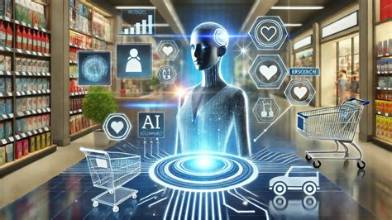
AI helps companies compete by making the shopping experience more relevant.
Personalized Product Recommendations
Recommendation engines can analyze browsing behavior, purchase history, search activity, preferences, and similar customer behavior.
Instead of presenting every visitor with the same product catalog, an AI-powered store can prioritize products that are more likely to interest each individual.
This can increase:
- Conversion rates
- Average order value
- Customer engagement
- Repeat purchases
- Customer retention
Personalization is particularly valuable for international businesses because different customer segments can have dramatically different preferences.
AI-Powered Shopping Assistants
Generative AI is also changing how customers interact with online stores.
Instead of navigating through dozens of categories, customers can increasingly describe what they want in natural language.
For example:
“I need a lightweight waterproof jacket for a three-day trip in northern Europe.”
An intelligent shopping assistant could interpret the request, identify relevant products, compare specifications, explain differences, and potentially help the customer complete a purchase.
The online store begins to behave less like a catalog and more like a salesperson.
That is a major shift in digital commerce.
AI Is Breaking Down Language Barriers
Language has historically been one of the biggest obstacles to international commerce.
A company entering a new market may need to translate:
- Product pages
- Advertisements
- Customer-support materials
- Contracts
- Marketing campaigns
- Email communications
- Product manuals
- Social-media content
Generative AI and machine translation can dramatically reduce the cost and time associated with these tasks.
More importantly, AI can go beyond literal translation.
Modern systems can help businesses adapt messaging to different cultural contexts, consumer expectations, and communication styles.
This means a small company can potentially reach international audiences without building a separate content operation for every country.
The result could be a significant expansion of the global addressable market for smaller businesses.
AI Is Changing International Marketing
Marketing has traditionally required significant research, creative production, testing, and analysis.
AI can accelerate nearly every part of this process.
A company can use AI to analyze customer segments, identify market trends, generate advertising variations, summarize customer feedback, create campaign concepts, and evaluate performance.
Generative AI is especially important because it reduces the cost of producing content.
Businesses can create variations of:
- Product descriptions
- Advertisements
- Social-media posts
- Email campaigns
- Landing pages
- Video scripts
- Sales materials
The important development is not simply that AI can generate content.
It is that AI can potentially generate different content for different audiences at scale.
A global company can develop a campaign concept and then adapt it for multiple markets, languages, customer segments, and channels.
This turns localization from a major operational challenge into something that can increasingly become an automated workflow.
AI Is Reshaping Supply Chains
Perhaps the most economically significant application of AI is happening behind the scenes.
Global commerce depends on complicated supply chains involving manufacturers, suppliers, warehouses, ports, transportation providers, distributors, retailers, and customers.
A disruption in one part of the system can create consequences thousands of miles away.
AI can help companies analyze:
- Historical demand
- Seasonal patterns
- Supplier performance
- Inventory levels
- Shipping information
- Weather conditions
- Market trends
- Transportation capacity
- Customer behavior
The goal is better prediction.
If an AI system identifies an increase in demand for a product, a company may be able to increase inventory before shortages occur.
If it detects declining demand, the company may reduce orders and avoid excess stock.
This is particularly important because inventory represents capital.
Too much inventory ties up money.
Too little inventory creates missed sales.
AI can help companies find a more efficient balance.
Predictive Demand Forecasting
Demand forecasting has always been difficult.
Businesses are effectively trying to predict the future using incomplete information.
AI improves the process by combining more variables than traditional forecasting systems can easily handle.
For an international retailer, those variables might include:
- Historical sales
- Search trends
- Weather
- Holidays
- Promotions
- Economic conditions
- Regional purchasing behavior
- Competitor activity
- Social-media trends
The more relevant data an organization has, the more sophisticated its forecasts can become.
Perfect predictions are impossible.
But even modest improvements in forecasting can produce significant financial benefits when applied across large operations.

AI Is Making Global Logistics More Efficient
Moving products across borders involves thousands of decisions.
Which warehouse should fulfill an order?
Which transportation route is most efficient?
How much inventory should be stored in each location?
Which shipments should receive priority?
Where are potential delays likely to occur?
AI can help answer these questions using real-time and historical information.
Route optimization can reduce unnecessary transportation costs.
Warehouse automation can improve fulfillment speed.
Predictive systems can identify potential delays before they become major problems.
For global companies operating at enormous scale, small improvements can translate into substantial savings.
AI and Dynamic Pricing
Pricing is another area undergoing major transformation.
Traditional pricing strategies often rely on fixed prices or periodic adjustments.
AI makes it possible to analyze market conditions continuously.
Depending on the business model, AI systems may consider:
- Demand
- Inventory
- Competitor pricing
- Customer behavior
- Location
- Time
- Seasonality
- Promotions
This can allow businesses to adjust prices more dynamically.
Airlines and hotels have used sophisticated pricing systems for years. Similar techniques are becoming increasingly relevant across e-commerce, retail, transportation, and digital services.
However, dynamic pricing also introduces ethical and regulatory questions.
Consumers may be uncomfortable if they believe different people are being charged different prices based on personal characteristics or behavioral data.
Businesses therefore need transparency, governance, and careful controls when implementing AI-driven pricing.
AI Is Transforming Customer Service
Customer support is another major area of change.
Global businesses need to support customers across time zones, languages, and communication channels.
Traditional support models can be expensive because they depend heavily on human agents.
AI-powered systems can handle many routine interactions automatically.
For example, an AI assistant can potentially answer questions about:
- Order status
- Shipping
- Returns
- Product specifications
- Account information
- Basic troubleshooting
- Frequently asked questions
Human employees can then focus on complex problems requiring judgment, empathy, negotiation, or specialized knowledge.
This creates a hybrid model:
AI handles scale. Humans handle complexity.
The best implementations are unlikely to eliminate human customer service completely. Instead, they will redesign how human teams spend their time.
AI Is Changing International Sales
Sales teams also benefit from AI.
For B2B businesses, selling internationally can involve identifying prospects, researching companies, qualifying leads, preparing proposals, following up, and maintaining relationships.
AI can automate or accelerate many of these activities.
Sales systems can analyze customer data and help identify accounts with higher purchasing potential.
AI can summarize meetings and conversations.
It can identify important topics from customer communications.
It can help sales representatives prepare for meetings.
It can generate personalized follow-up messages.
It can also help forecast which opportunities are most likely to close.
The salesperson remains responsible for the relationship, but AI becomes an intelligence layer supporting the process.
Small Businesses Can Become Global Businesses Faster
One of the most important consequences of AI may be its impact on small businesses.
Historically, international expansion required substantial resources.
A company might need:
- International marketing teams
- Translators
- Customer-support staff
- Data analysts
- Sales representatives
- Local consultants
- Operations specialists
AI can reduce some of these barriers.
A small company can use AI tools to research international markets, localize content, automate customer support, analyze advertising performance, and manage repetitive administrative tasks.
This does not mean every small business will suddenly become an international corporation.
Market knowledge, regulation, logistics, financing, and product-market fit still matter.
But AI can lower the operational threshold required to experiment internationally.
A company that previously served one city may now be able to test demand in several countries without immediately building large teams in each market.
The Rise of AI-Native Commerce Companies
AI is not only improving existing businesses.
It is also enabling entirely new business models.
An AI-native commerce company can be designed around automation from the beginning.
Instead of building a large organization and later adding AI, founders can create workflows where AI is integrated into research, marketing, customer service, sales, operations, and analytics from day one.
This can create extremely lean companies.
A small team may potentially manage operations that previously required dozens of employees.
The competitive advantage comes from organizational design, not simply from owning an AI tool.
The companies that benefit most will likely be those that redesign processes around AI rather than adding AI to outdated processes.
AI Is Changing Consumer Expectations
Technology changes what customers consider normal.
Once customers become accustomed to personalized recommendations, instant responses, real-time delivery tracking, and conversational shopping experiences, slower experiences can begin to feel outdated.
This creates a competitive feedback loop.
One company introduces an AI-powered experience.
Customers enjoy it.
Competitors adopt similar technology.
The new experience becomes standard.
Eventually, customers expect it everywhere.
This is how AI can transform entire industries even when individual companies are not deliberately trying to reinvent them.
The New Competitive Advantage: Intelligence at Scale
For much of modern business history, competitive advantages came from assets such as:
- Capital
- Manufacturing capacity
- Distribution networks
- Brand recognition
- Physical locations
- Large workforces
These advantages remain important.
But AI introduces another one:
the ability to convert information into decisions quickly.
Two companies may have access to similar data.
The company that can analyze that data faster, identify opportunities sooner, and execute more efficiently may gain an advantage.
This makes organizational intelligence increasingly important.
The future global company may not necessarily be the company with the largest workforce.
It may be the company with the best combination of people, data, AI systems, processes, and decision-making infrastructure.
The Risks of AI in Global Commerce
The AI revolution also creates serious challenges.
Businesses should not assume that automation automatically produces better outcomes.
AI systems can make mistakes.
They can inherit biases from training data.
They can generate incorrect information.
They can make poor recommendations when circumstances change.
They can also create privacy and cybersecurity risks.
Data Privacy
Global commerce involves enormous amounts of personal and commercial information.
Businesses must carefully consider how customer data is collected, stored, processed, and shared.
AI does not remove privacy obligations.
In many markets, regulations impose strict requirements around personal data and automated decision-making.
AI Bias
AI systems can reproduce biases present in their training data.
In commerce, this could potentially affect:
- Advertising
- Lending
- Insurance
- Hiring
- Pricing
- Customer segmentation
- Fraud detection
Organizations therefore need testing and monitoring rather than assuming that an automated system is neutral.
Over-Automation
Not every business decision should be automated.
A customer experiencing a complicated problem may want to speak to a human.
A strategic supplier negotiation may require judgment.
A major investment decision may involve information that cannot easily be reduced to a prediction.
The goal should not be maximum automation.
It should be better automation.
AI and the Future of Jobs in Commerce
One of the biggest questions surrounding AI is what happens to human employment.
Some repetitive tasks will almost certainly become automated.
But automation does not necessarily mean that entire professions disappear.
More often, jobs change.
A customer-support employee may spend less time answering repetitive questions and more time solving difficult cases.
A marketer may spend less time producing basic content and more time developing strategy.
A salesperson may spend less time researching prospects manually and more time building relationships.
An analyst may spend less time preparing reports and more time interpreting business implications.
The valuable skill is increasingly becoming the ability to work effectively with intelligent systems.
The Importance of Human Judgment
AI can analyze enormous amounts of information.
But commerce is ultimately about people.
Customers have emotions.
Markets change unexpectedly.
Political and economic conditions can shift.
New competitors can emerge.
Cultural differences can be subtle.
A business decision that appears optimal according to historical data may fail because the world has changed.
Human judgment therefore remains essential.
The most successful organizations will likely combine machine intelligence with human context.
AI can answer:
“What does the data suggest?”
Humans still need to answer:
“What should we do, and why?”
The Next Stage: Autonomous Commerce
The most ambitious development is the possibility of increasingly autonomous commerce.
Imagine an AI system that can:
- Detect an increase in customer demand.
- Analyze available inventory.
- Forecast future requirements.
- Contact suppliers.
- Compare supplier prices.
- Recommend or initiate procurement.
- Adjust advertising campaigns.
- Update product recommendations.
- Coordinate logistics.
- Monitor customer feedback.
This is moving beyond AI as an assistant.
It becomes AI as an operational system.
The technology required for fully autonomous commerce is still developing, and businesses will need safeguards before allowing AI systems to make high-impact decisions independently.
Nevertheless, the direction is clear.
AI is moving from generating information toward taking action.
AI Agents Could Change How Commerce Works
The emergence of AI agents could be particularly significant.
Traditional software waits for a human to interact with it.
An AI agent can potentially monitor a situation, reason about a goal, use software tools, and execute a sequence of actions.
In commerce, this could create new forms of automation.
For example, an AI purchasing agent might monitor inventory and recommend when to reorder.
A marketing agent might continuously analyze campaign performance and suggest changes.
A sales agent might identify prospects and prepare outreach.
A customer agent might resolve routine service issues.
The important distinction is that agents can operate across multiple steps rather than performing one isolated task.
That could make business automation much more powerful.
The Future of Global Commerce Will Be Hybrid
The future is unlikely to be humans versus AI.
It will be humans with AI.
Companies will combine:
- Human creativity
- Human relationships
- Human judgment
- Machine intelligence
- Predictive analytics
- Automation
- Generative AI
- Real-time data
The organizations that understand this combination will have an advantage over those that treat AI simply as a productivity application.
The real transformation is organizational.
Businesses need to rethink how work flows through the company.
Instead of asking:
“Where can we add AI?”
Leaders should ask:
“If we designed this process today with AI available from the beginning, how would we build it?”
That question can reveal much larger opportunities.
How Businesses Can Prepare for the AI Commerce Revolution
Companies do not need to automate everything immediately.
A practical approach starts with identifying areas where AI can create measurable value.
1. Identify Repetitive Processes
Look for activities that consume large amounts of employee time without requiring significant judgment.
These are often strong candidates for automation.
2. Improve Data Quality
AI depends heavily on data.
Poor-quality information produces poor results.
Businesses should therefore invest in clean, accessible, well-organized data before expecting AI to solve every problem.
3. Start With High-Value Use Cases
Do not adopt AI simply because competitors are doing it.
Identify specific problems.
For example:
- Customer response times are too slow.
- Inventory forecasting is inaccurate.
- Sales teams spend too much time researching prospects.
- Marketing localization is expensive.
- Product descriptions take too long to create.
Then test AI against the problem.
4. Keep Humans in the Loop
High-impact decisions should have appropriate human oversight.
AI should support decision-making rather than automatically control every important business process.
5. Measure Results
AI initiatives should be evaluated using measurable outcomes.
Potential metrics include:
- Revenue
- Conversion rate
- Customer satisfaction
- Operating costs
- Response time
- Employee productivity
- Inventory turnover
- Customer retention
If an AI system does not produce meaningful improvement, the business should reconsider how it is being used.

The Global Commerce Advantage Is Becoming Digital
Global commerce has already been transformed by the internet.
The next transformation is intelligence.
The internet connected buyers and sellers.
Cloud computing gave businesses scalable infrastructure.
Mobile technology put commerce into consumers' hands.
AI is beginning to make the entire system more adaptive.
It can help businesses understand customers, predict demand, optimize operations, personalize experiences, automate workflows, and enter new markets.
This creates an enormous opportunity.
A company in one country can increasingly operate like a global business without building traditional infrastructure in every market.
At the same time, established multinational companies can use AI to coordinate increasingly complex global operations.
The result is a marketplace that can become faster, more personalized, and more competitive.
Final Thoughts: AI Will Not Replace Global Commerce — It Will Redesign It
The AI revolution in global commerce is still in its early stages.
Today's AI applications may eventually look basic compared with what becomes possible as models improve, businesses collect better data, and autonomous systems become more reliable.
The biggest transformation will not come from one chatbot or one AI application.
It will come from thousands of small improvements across the commercial ecosystem.
A faster customer response.
A more accurate forecast.
A better product recommendation.
A smarter supply chain.
A more efficient warehouse.
A localized marketing campaign.
A better sales decision.
A more secure transaction.
Together, these improvements can fundamentally change how global commerce operates.
The companies that succeed will not necessarily be those that use the most AI.
They will be those that understand where intelligence creates economic value and how to combine AI with human expertise.
Global commerce is entering an era in which geography still matters, but information can move almost instantly.
Businesses can increasingly understand customers across borders, coordinate complex operations, and personalize experiences at a scale that was previously impossible.
The question is no longer whether AI will influence global commerce.
It already does.
The more important question is:
Which businesses will redesign themselves around this new reality—and which will continue operating according to the assumptions of the past?
The AI revolution is not waiting for the future.
It is becoming the infrastructure of commerce today.
Want More In-Depth AI, Technology, and Future Innovation Insights?
If you enjoyed this article and would like access to more exclusive content covering artificial intelligence, psychology, technology, digital transformation, business innovation, entrepreneurship, data science, and the future of work, join my communities on the platforms below. I regularly publish premium articles, expert analysis, research, practical guides, and exclusive content designed to help readers stay ahead in the rapidly evolving world of AI and emerging technologies.
⭐ Become a Patreon Member
Support independent research and gain access to exclusive articles, early releases, premium content, behind-the-scenes updates, and future AI reports.
👉 Patreon:
https://patreon.com/GlobalAIIntelligence2026?utm_medium=unknown&utm_source=join_link&utm_campaign=creatorshare_creator&utm_content=copyLink
📩 Subscribe on Substack
Receive exclusive newsletters, premium long-form articles, industry insights, AI trends, and subscriber-only content delivered directly to your inbox. 👉 Substack:
https://substack.com/@mrscallimi
⭐ Become a Substack Member
Support independent research and gain access to exclusive articles, early releases, premium content, behind-the-scenes updates, and future AI reports. 👉 Substack :
https://substack.com/@mrscallimi
Stay Ahead of the AI Revolution
The world is changing faster than ever. By joining these communities, you'll gain valuable insights into:
- 🤖 Artificial Intelligence
- 🧠 Psychology and Human Behavior
- 📊 Data Science & Analytics
- 💼 Business & Entrepreneurship
- 💻 Digital Transformation
- 🚀 Emerging Technologies
- 📈 Future Careers & Skills
- 🔬 AI Research & Innovation
- 🌍 Global Technology Trends
Thank you for reading and for supporting independent research. Together, we can better understand the technologies shaping our future.